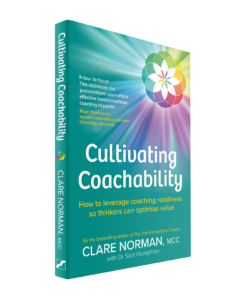

We are two weeks away from the publication of “Cultivating Coachability: How to leverage coaching readiness so thinkers can optimise value”. Is it on your radar? Pre-order now on Amazon or any good bookshop of your choice. One of the things I have been pondering since writing Cultivating Coachability is how we might structure our
For coaches
Why every coach needs supervision
One of the things I say over and over again in Cultivating Coachability, available now to pre-order, is to take your questions, wonderings and objections to supervision. You may well get sick of me saying, “Take this to supervision if you are unsure of yourself” or words to that effect, but it’s the best place
Personal Development Part Six: Digital Health
I’m a bit (a lot) addicted to my phone. Apps are made to be addictive (see Hooked: How to Build Habit-Forming Products by Nir Eyal). I worry about this – for myself, for children, for mental health, for relationships, for the opportunity costs. I spend too long staring at a screen. It’s not good for

Personal Development Part Five: Extra-curricular Activities
Do you paint? Or make? Or model? How might something creative support your personal development? And your stress levels. I paint with watercolours. Part of the reason for this choice is to practice being ok with not being able to control the final picture. I have needed to develop this in my coaching, and it
Personal Development Part Four: Bodywork
Shiatsu supports my personal development, both for life and for my coaching. This is another in my series of ways to become a better coach that doesn’t involve professional development. If you don’t know what shiatsu is, it’s a form of bodywork. It’s a bit like reflexology that focuses on your feet, but this is
Personal Development Part Three: Physical and Mental Health
Movement, oxygen, brain food, hydration, sleep, time in nature, managing stress: these all support our thinking processes. We can encourage the people we work with to pay attention to each of these. But what are you doing for yourself, so that you show up in the best physical and mental state to work with them?

Reflections on your own coachability
How do you show up to coaching for you? Would you say that you are coachable? And/or coaching ready? You know the saying that we can only work with others to the depth that we have gone ourselves. So are you all in when you are being coached? This is a question that Patrick Harding

Supporting Midlife Women in the Public Sector
I’d like to introduce you today to Sarah Clein and her blog post that outlines her experience of working with mid-career women in the public sector. This is one of our series on coaching in different industries. I hope you are enjoying the different lenses through which my guest bloggers are seeing the power of

Thinking Accelerators
How can you accelerate your thinking (whether that’s for the purpose of being coached or outside of coaching)? There are five major accelerators. The idea for accelerators came from the work of my friends at Accenture, particularly Dana Koch, who talks about them as learning accelerators. The five are: Sleep, exercise, attention restoration, nutrition, and

Mastery of Thinking
Since I became a Master Certified Coach a few weeks back, I have mastery on the brain. But not mastery for coaches, mastery for thinkers. How can you, as the thinker, master your thinking? William Buist writes about Intentional Mastery. He suggests that: Mastery is enhancing and honing your wisdom. It’s about who you are

The Thinker’s Mindset – Part 6
We coach the person, not the problem (Franklin 2019, Reynolds 2020), meaning we focus on “who” the thinker wishes to be at an identity level, such that they can “do” things that match up to this person they wish to be, coming from a place of grounded beliefs, values and mindsets. To coach the person,

The Thinker’s Mindset – Part 5
We access the wisdom of multiple intelligences, not just the cerebral rational intelligence. Be prepared to get creative in coaching. Your cerebral, rational intelligence will not have all the answers, or it might get stuck or be lost for words. Your coach may invite you into experiments that might feel a little different from the
The Thinker’s Mindset – Part 2
The aim of coaching is to move the thinker beyond known thinking to new thinking. Coaching is unlike any conversation you have ever had. In “normal” conversation, you probably update people with stories or context about what has happened, bringing them up to speed. You don’t need to do that in coaching. You already know
The Thinker’s Mindset – Part One
Having written about the mindsets that a coach must unlearn in order to be an extraordinary coach, I got to wondering about the mindset of a thinker. How might the thinker show up to coaching in a way that would enable them to make the most of the thinking time. Because that’s what coaching is:

My philosophy of coaching
I was coaching a business owner the other day who wanted to figure out his philosophy about leadership development so that he could articulate it clearly and succinctly on his website. And, as often happens as I reflect back on coaching sessions, I realised that this was something I could do for myself as well.
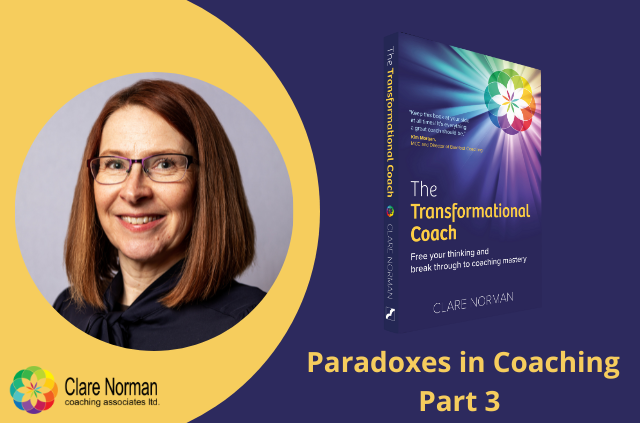
Paradoxes in Coaching – Part 3
Life and work are full of paradoxes, opposites, polarities, dichotomies, oxymorons, contradictions. So too is coaching. I noticed several as I was writing my book, The Transformational Coach: Free Your Thinking and Break Through to Coaching Mastery. So to give you a sneak peek at the content of the book, I thought I would share