
I was coaching a business owner the other day who wanted to figure out his philosophy about leadership development so that he could articulate it clearly and succinctly on his website. And, as often happens as I reflect back on coaching sessions, I realised that this was something I could do for myself as well. In my case, articulating my philosophy of coaching. And maybe it might stimulate some ideas for you about your own philosophy.
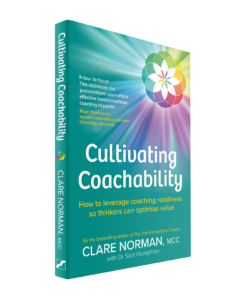
You could say that my book brings my philosophy to life. So go ahead and order it if you want to delve deeper into the mindsets that I have found to be the most useful.
Behind those mindsets are my set of philosophical underpinnings:
- We (coach and thinker) are co-travellers, travelling into the unknown together, designing the map as we go, because there is no map for this person’s unique journey.
- The aim of coaching is to move the thinker beyond known thinking to new thinking.
- Therefore, curiosity is for the benefit of the thinker’s new thinking, not the coach’s understanding.
- The thinker is “creative, resourceful and whole” (Whitworth et al, 1998) and my job is to strengthen their thinking muscles, not do the thinking for them.
- We access the wisdom of multiple intelligences, not just the cerebral rational intelligence.
- We coach the person, not the problem (Franklin 2019, Reynolds 2020), meaning we focus on “who” the thinker wishes to be at an identity level, such that they can “do” things that match up to this person they wish to be, coming from a place of grounded beliefs, values and mindsets.
- To coach the person, we use a vertical (challenging old assumptions and testing new hypotheses of being) development approach rather than horizontal (building task expertise) (Petrie, 2014).
- Every coaching session is individualised to the in-the-moment needs of the thinker with whom we are working. No two session outcomes are ever the same.
- The coach’s responsibility is for the process, the thinker’s responsibility is for the outcomes.
How do these principles resonate with you?
Whitworth, L., Kimsey-House, H. and Sandahl, P. (1998) Co-active Coaching, Palo Alto, CA: Davies Black Publishing.
Franklin, M. (2019) The Heart of Laser-Focused Coaching: A Revolutionary Approach to Masterful Coaching, Wilmington: Thomas Noble Books.
Reynolds, M. (2020) Coach the Person, Not the Problem: A Guide to Using Reflective Inquiry, Oakland, CA: Berrett-Koehler Publishers.
Petrie, N. (2014) Future Trends in Leadership Development. Center for Creative Leadership white paper.