
We’ve almost come to the last chapter, with our employee experience journey, where we started with the employee joining the workforce and now we are looking at coaching to support leaving the organisation – or even leaving the workforce through retirement.
If you are just joining our journey now, you might want to catch up on what we’ve covered so far – the theme being how coaching can support change and the human transition within that change.
We started by looking at the employee journey through the employee lens: Right people, right place, right time – the employee’s perspective
From there, we looked at The career sweet-spot – helping the employee to find that sweet-spot.
We looked at coaching roles to support the employee experience, through three lenses:
- Coaching roles to support the employee experience: the coachee’s lens
- Coaching roles to support the employee experience: the coach’s lens
- Coaching to support the employee experience: the organisational lens
And latterly, we’ve been working our way through each of the change points in the employee experience.
- The employee experience: re-joining the workforce
- The employee experience: joining the workforce
- Coaching the Employee Experience: Change in Role
- The Employee Experience: Coaching to Change Role
And that brings us to leaving the organisation or the workforce.
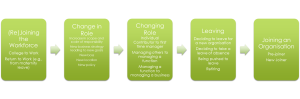
There are various reasons for leaving an organisation, and the coaching for each reason is likely to be different.
Coaching to support leaving an organisation – when the employee makes the decision
The person who has decided to leave for a new organisation will want to close down their relationship with this organisation and the people in it, without burning any bridges – who knows whether they may want to come back in future, or be considered for a role in another organisation by a former leader in the company they are now leaving who has moved to that organisation. It’s quite likely that the employee in this position may not even be thinking about ending well, but they’ll need to do that so that they don’t take old baggage with them into the new organisation. You cannot have a good new beginning until you’ve had a good ending – I know, it sounds back-to-front, but think about it.
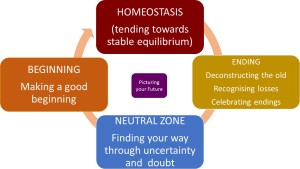
So the employee who is leaving the organisation may consider using a coach to help him/her to:
- Make a good ending of their current role; saying all their thank yous and good-byes; celebrating the ending; letting go
- Get themselves physically and mentally fit for the new start
- Organise him/herself to be effective
- Identify what they need to learn and from what sources
- Bring the best of who they are into this unique culture; being authentic and significant
That will take them through the ending and the neutral zone, and we’ll talk about the coaching they may want in their first 90 days of their new role in the next post.
It’s possible that with a good relationship, the manager could provide the coaching here – but it’s likely that his/her time will be swallowed up with finding a replacement. So if time only allows for a good-bye and good luck, the coaching may come from an internal or external coach. The organisation likely won’t pay for this coaching, which probably means the employee will need to choose and pay for their own external coach in this circumstance.
Coaching to support leaving an organisation – when the employee is taking a leave of absence
Let’s say you have decided to go back to college to study. Or you’ve decided to travel the world and your organisation has agreed to give you a leave of absence. Some enlightened organisations actually encourage sabbaticals – the employee comes back refreshed and with renewed vigour and ideas for the work. It’s less likely that they will offer you coaching to help you to make the transition out of the workplace and into your sabbatical, but it’s a great idea, as this is just as much of a change as any other you will encounter in your career and life.
You might use coaching to help you to wrap up your work, prioritising what you can and cannot accomplish in the days and weeks before you go. You may also use it to consider what how you want to shape the sabbatical, so that you get what you want out of it; and who you want to be in the new surroundings, for example how do you want to introduce yourself to your fellow students, or to fellow travellers, and what new ways of being do you want to “try on for size”?. You may have logistical things to consider, such as renting out your house, or finding someone to look after your cat while you are away, and it can help to talk through options.
When you re-join the workforce, you may want coaching again to make the shift back into the working world. Both ways, there will be some psychological stuff going on too – about what you are losing and leaving behind, and what you don’t know about the new situation.
Here again, it seems likely that the employee will need to seek their own external coach for this.
Coaching to support leaving an organisation – redundancy
Redundancy has particular coaching needs. There are the practicalities of finding a new role. But there is also the emotional turmoil to work through. I’m going to come back to this in a separate post, as I have a lot to say about it (having experienced redundancy myself). You can’t get practical until you’ve got over the betrayal and the denial, and the loss of identity. So we’ll talk about how coaching can support that process before outplacement can be successful.
Coaching to support leaving an organisation – retirement
Coaching to support a person as they move into retirement is rare, but really important, to enable a person to reflect on their life and identity to date, and to figure out a new identity. This is a big ending, with each individual reacting differently to the losses and the gains. People can feel lost, in the neutral zone, trying to figure out what this new phase in their life will look like; and possibly looking at the legacy they want to leave behind.




Hi Clare – strange to say, but I’ve only just come across your site. Really interesting stuff – I shall be working my way back through the employee journey. Thank you.