
This is the final extract from my upcoming book, Mentor Coaching: A Practical Guide. If this piques your interest, you can pre-order here If you are not a coach, I hope you might still be taking this journey with us as you might still learn something about leadership in roundabout ways.
My motivation for mentor coaching is simple.
I want to professionalise the coaching industry.
There are so many people out there who call themselves coaches, who have had little to no training – and are probably not coaching anyway. That dilutes the value that trained coaches bring to the world, as noted in the 2016 research by the ICF which found that the “main concern expressed by coach practitioners was untrained individuals who call themselves coaches”.
The value that trained coaches bring is in the “joint endeavour to discover new thinking that moves the thinker forward” (Norman, 2019). Coaching “is intended to foster the on-going self-directed learning and personal growth of the coachee” (Grant, 1999) and according to ICF and Human Capital Institute research in 2018, the “use of professional coaching practitioners is considered among the most helpful activities in achieving the goals of a change management initiative.”
[If you prefer to listen to an audio version of this and the other 3 extracts from the book, you can listen here: https://www.spreaker.com/show/extracts-mentor-coaching-a-practical-gui]
I notice that some coaches hold onto the belief that the value they bring to their thinkers is in the ideas they give them, the solutions they offer, the benefit of their experience. This feels like a short-term fix and doesn’t necessarily lead to long-term sustainable change (Koroleva, 2016). I want to encourage coaches to be more non-directive, because I have seen how much of a difference this makes to people and their confidence in themselves. Parsloe and Wray (2000) state that performance is enhanced when “control and responsibility is transferred from the coach to the learner.”
I want to ensure that every coach partners with their thinker in a way that leads to better, new thinking for the world as a whole. I believe (per Marshall Rosenberg, 2015) that the more each person can articulate their own needs and make requests from those around them, the better the world will become. That may sound naïve but that’s what drives me as a coach and therefore as a mentor coach.
Support & challenge
To me, it’s important to support and challenge coaches to re-sharpen their edge, repeatedly, so that they can be the best coach they can be for their thinkers. This will increase the reputation of the coaching industry, as more thinkers experience great coaching that moves them forward and enables them to sustain change. My second motivator is around my own development. I notice how much I learn and grow by watching other coaches and identifying where they shine and where their edge is not so sharp. I often find myself saying that I might use something that a mentor coachee has just used. For example, I recall a time when I realised that open questions that start with how and what are best used during the exploration phase of the coaching as they invite expansive answers; when, where and who are more useful when we get to planning and goal-setting and wish to pin the thinker down. It also reminds me where I need to develop and grow.
When I spot a place where a mentor coachee could have been braver with some direct communication, for the benefit of the thinker, that reminds me about doing the same myself. Either way, I am developing the profession as I develop myself and develop other coaches. I do enjoy working with other coaches. Mentor coaching is definitely in my sweet-spot, where my strengths overlap with what I like to do and the people I like to work with – and all of that contributes to a change that I see that the world needs, around people expressing their needs.
Those are my motivators. Yours may be different. Perhaps an additional revenue stream for example, or a desire to teach and share experience. Whatever your motivation, go ahead and pre-order my book for more insights into the practicalities of mentor coaching.
The three elements
There are three main elements of mentor coaching: creating a safe space, managing the feedback process, and enabling the feedback to be heard. These map to the three elements a coach needs to pay attention to when they are preparing for mentor coaching: their willingness to be vulnerable to practice; their capacity to give feedback; their willingness to receive feedback. 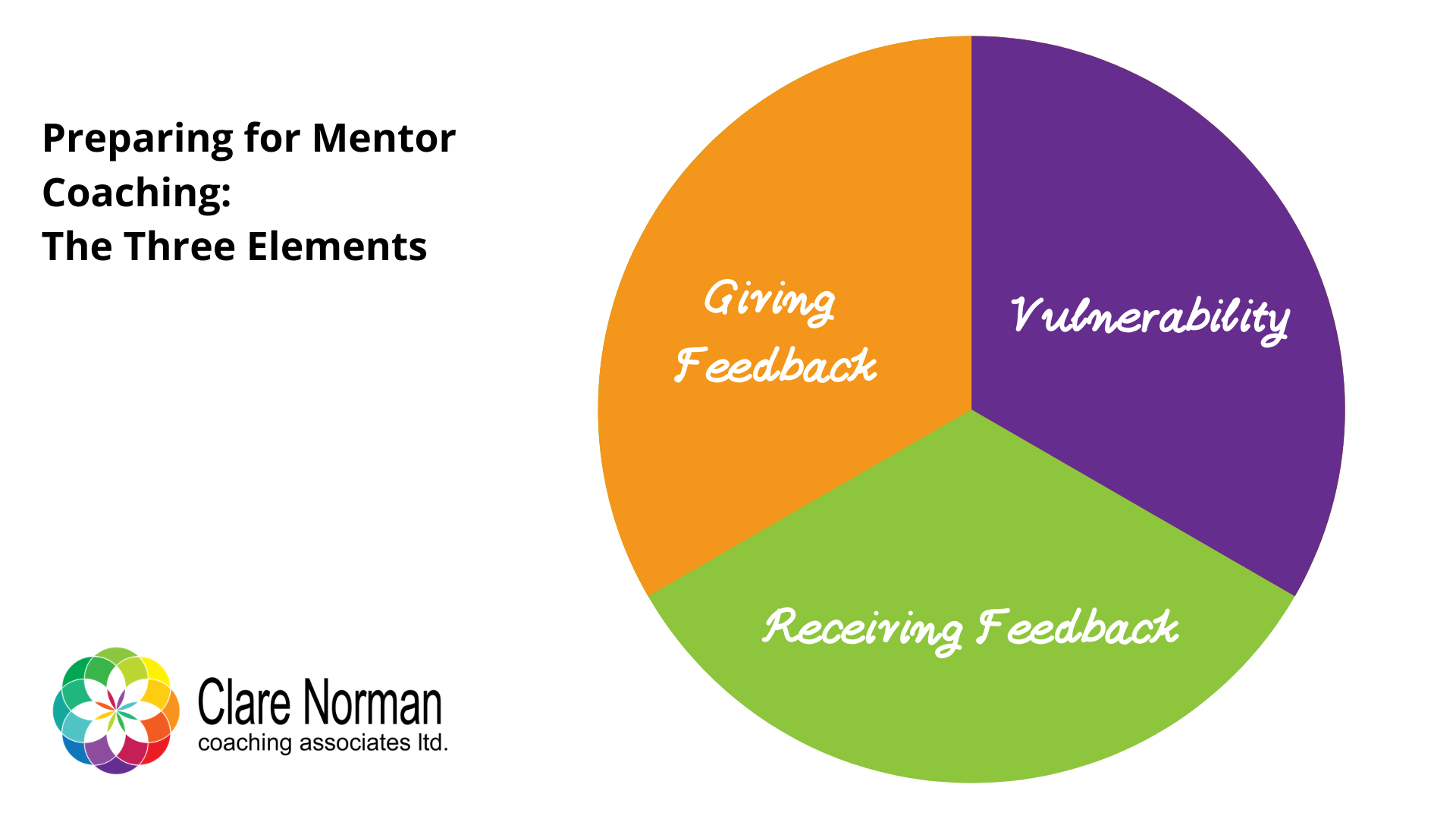
Learn more about each one in the book, alongside how to manage a group and how to run virtual mentor coaching programmes. Pre-order it now I will also be releasing further materials on my website to support mentor coaches and am planning training for mentor coaches, to bring the theory to life. If this is of interest to you, please register your interest here: