As a leader, we need self-confidence. I work with a lot of leaders who lack inner self-confidence, although they put a brave face on it. Some might call it imposter syndrome – thinking you will be found out sooner or later. But much of the time, we are simply facing situations that we have never faced before, so it is no wonder we feel a bit of a wobble.
There are several things we need to be confident about – most of them, we have explored already in this series. Being ok with:
- Support and Challenge
- Task focus and Relationship focus
- Vulnerability and Strength
- Giving and Receiving
- Advocacy and Inquiry
- Holding accountable and Trusting
- Informal communication and Formal communication
- Unified team and Diverse individuals
- Flexible schedule and Structured schedule
- Strategy and Operations
That’s a lot! We may be more confident in some areas than in others. Or more confident on one side of the equation than the other. None of us is an “all or nothing”. We have strengths and we have development areas.
So where are you most confident; and where do you need to develop your skills in the above?
We build confidence by trying things out. That means we need to start trying those things we haven’t tried previously. Not worrying overly about the “what ifs”. Just starting small, building confidence bit by bit. I worked with a woman on this today. She has been putting something off for weeks and decided to start much smaller than she had been planning – thus making that first step more manageable and more likely to happen.
We’re also not aiming for overconfidence. That arrogance can get in our own and others’ way. We can develop blind spots if we think we are brilliant at everything. But I notice that people who are underconfident are really worried about seeming to be arrogant. That’s quite a swing to an opposite extreme, so if you are under-confident, you probably don’t need to worry about appearing arrogant as that would be a – or probably several – big step(s).
So where are you on the confidence scale?
At the same time as being confident in ourselves, we need to have confidence in others…trusting that they can take some of the work off our plate, as we discovered in Hold accountable and Trust and Task and Relationship. But it’s not just trusting them, it’s also showing that we believe in them, in their capabilities, in their strengths. Helping them to build that self-confidence in their own skills. Just like you would want to help a son or daughter to become independent of you and confident in their own abilities, leaders need to help their people to become independent of them and confident in their own abilities.
We can only do this if we don’t take too much of the limelight.
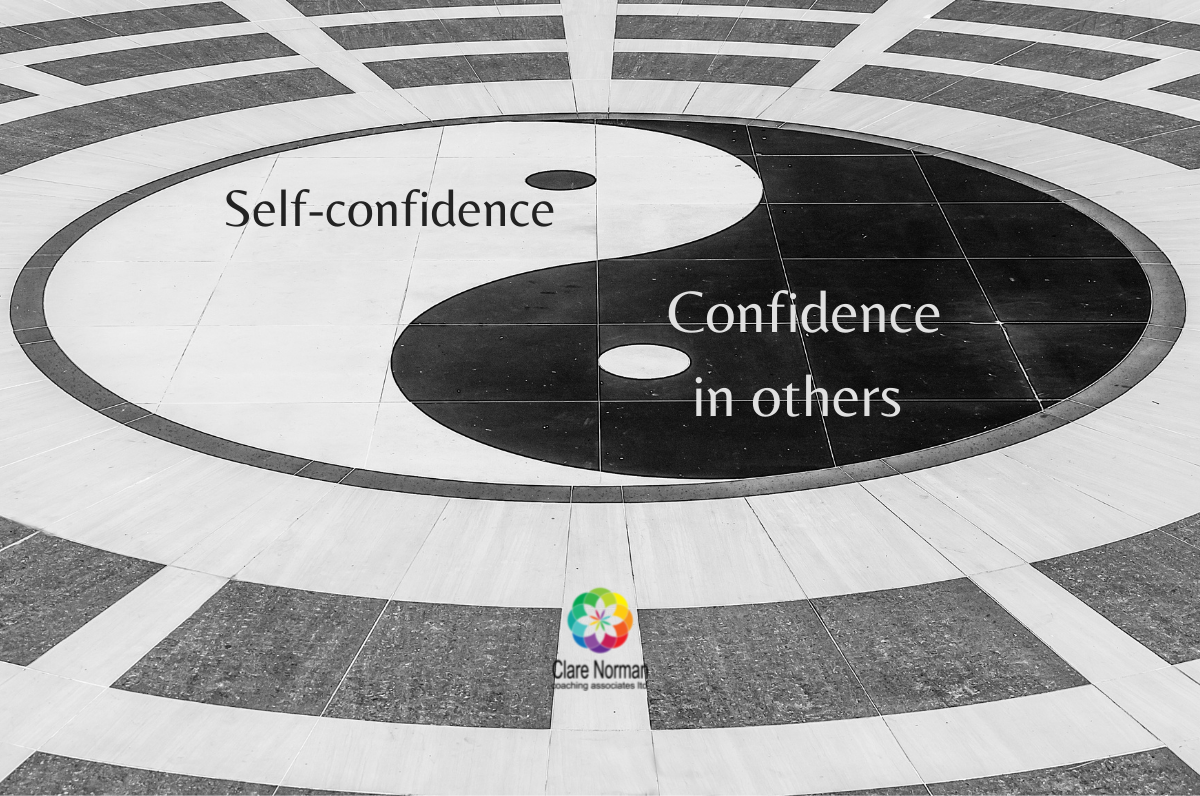
They need the limelight too. They need opportunities to shine. This is where the yin and yang comes in. If we are too overconfident and too greedy with that limelight, stepping in to answer questions that they could answer themselves for example, then we steel their self-confidence. But if we aren’t confident enough, they may not think us credible and may not have confidence in our decisions.
So once again, it is about getting that balance right. And once again, you can see that this applies whether you are working virtually or not. I hope your confidence in yourself has grown over the past 18 months in the virtual arena, but if not, that might be something to focus on. Rather than saying “virtual is just so difficult,” as I hear many people saying, change the frame. If you were to treat it as normal and, dare I say it, easy, how would that change your confidence levels in leading virtually?
What do you think? Does this resonate with you? What do you do to get the balance right? How do you boost your own confidence when you feel under-confident how do you boost that of your people?