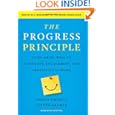
 I recently read a new book, called the Progress Principle, by Teresa Amabile and Steven Kramer. They have done years of research into what motivates people to higher performance, using daily diaries to elicit how people are feeling as a result of events. If you’ve previously read Drive by Dan Pink, you’ll also recognise some of the elements of his research around helping people to move towards mastery, automomy and purpose.
Here’s how they suggest supervisors can support people to perform on an ongoing basis.
The very short summary: “A fundamental management principle: facilitating progress is the most effective way for managers to influence inner work life. Even when progress happens in small steps, a person’s sense of steady forward movement toward an important goal can make all the difference between a great day and a terrible one”. “Any manager’s job description should start with facilitating subordinates’ progress every day.”
Teresa and Steven’s summary of what a manager can/should do: http://www.progressprinciple.com/books/resources/tips_from_the_progress_principle
And look for the progress checklist in the book – I highly recommend it for new and experienced supervisors alike.
For more insights, here are a few of the notes I made from the book…..
“Three types of events stand out as particularly potent forces supporting inner work life, in this order: progress in meaningful work; catalysts (events that directly help project work); and nourishers (interpersonal events that uplift the people doing the work”.
“The negative forms – or absence of – the key three events powerfully undermine inner work life: setbacks in the work; inhibitors; and toxins (interpersonal events that undermine the people doing the work). Negative events are more powerful than positive events, all else being equal”.
“Unfortunately, the conventional rules [of management] miss the fundamental act of good management; managing for progress.” “Few things can nurture work life as much as being successful”.
“Over 28 percent of the small events triggered big reactions. In other words, even events that people thought were unimportant often had powerful effects on inner work life”.
“Three major processes that, according to psychological research, influence performance: perceptions (also called thoughts or cognitions), emotions (or feelings) and motivation (or drive)”.
“Despite the Star Trek premise that Mr Spock’s purely rational, emotionless thought processes led to better decision making, in fact the opposite is true – at least for humans. Research on patients suffering damage to emotion centers in the brain reveals decision-making impairment even though they are quite normal cognitively”.
“As a result of these neural interconnections, individuals’ performance – the work they choose to do, how hard they work at it, how creative they are, how they behave toward coworkers – depends on a complex interaction of their thoughts, feelings and drives.”
“Managers who realize this have a valuable opportunity. By taking actions that support inner work life, they can simultaneously become heroes to their employees, build the long-term success of their organizations, and add meaning to their work as managers – which in turn will nurture their own inner work lives.”
“As inner work life rises and falls, so does performance”. “People do better work when they are happy, have positive views of their organization and its people, and are motivated primarily by the work itself. For short periods, people can perform at very high levels of stress, but this happens only under special conditions…over the long-haul, and under most conditions, people perform better when their inner work lives are positive.”
“Across all study participants, there was a 50 percent increase in the odds of having a creative idea on days when people reported positive moods, compared with days when they reported negative moods”.
“Most people were more creative when they perceived their assignments as challenging, and when they had autonomy in carrying out those assignments.” “People are more creative when they are driven primarily by intrinsic motivators: the interest, enjoyment, satisfaction, and challenge of the work itself – and not by extrinsic motivators: the promise of rewards, the threat of harsh evaluations, or the pressures of win-lost competitions or too-tight deadlines”.
“We discovered that the inner work life effect operates in three primary ways: attention to tasks, engagement in the project, and intention to work hard. When inner work life is good, people are more likely to pay attention to the work itself, become deeply engaged in their team’s project, and hold fast to the goal of doing a great job. When inner work life is bad, people ar emore likely to get distracted from their work, disengage from their team’s projects and give up on trying to achieve the goals before them”.
“You can foster positive inner work life with a vast array of everyday events at work”
“Making headway on meaningful work brightens inner work life and boosts long-term performance. Real progress triggers positive emotions like satisfaction, gladness, even joy. It leads to a sense of accomplishment and self-worth as well as positive views of the work and, sometimes, the organization. Such thoughts and perceptions (along with those positive emotions) feed the motivation, the deep engagement, that is crucial for ongoing blockbuster performance.” This is the “progress loop, the self-reinforcing process in which progress and inner work life fuel each other”
“Small wins often had a surprisingly positive effect, and small losses a surprisingly strong negative one”. Think about World of Warcraft or similar games…”What keeps them hooked? To a large extent, it’s two things: constant progress indicators and achievement markers. Both leverage the progress principle. These bars are tangible indicators of how close the player is to reaching the next major game level, the next step within the current level, and the next mini-goal within the current step. Achievement markers are a bit like badges that Boy Scouts and Girl Scouts can earn for mastering particular tasks”.
“Any manager’s job description should start with facilitating subordinates’ progress every day.”
“one of the most basic human drives is toward self-efficacy – a person’s belief that he or she is individually capable of planning and executing the tasks required to achieve desired goals.” “The strong need for self-efficacy explains why everyday work progress stands out as the key event stimulating positive inner work life. It also explains why everyday work setbacks are particularly harmful.”
“If you want to foster great inner work life, focus first on eliminating the obstacles that cause setbacks. Why? Because one setback has more power to sway inner work life than one progress incident”.
“What matter is whether you perceive your work as contributing value to something or someone”. “Managers should make sure that employees know just how their work is contributing. And, most importantly, managers should avoid actions that negate the value”
“The progress loop is a secret weapon of high-performance companies; it produces a powerful win-win for both managers and employees. Consistent daily progress by individual employees fuels both the success of the organization and the quality of those employees’ inner work lives. To harness this powerful force, you must ensure that consistent forward movement in meaningful work is a regular occurrence in your employees’ daily work lives, despite the inevitable setbacks that all nontrivial work entails.”