
I have published five books over the past ten years, all through different publishing routes. So many people ask me about the difference between them that I thought it would be worth writing it all down. If you have been wondering about this yourself, I hope this post is useful to you. And feel free to forward it to anyone who is at this stage of figuring out which route to go.
I’ll share in the order that I wrote them (don’t read anything into that, by way of preference).
Self-publishing
I wrote my first book, Being A Sunbeam, for my nephews and God-children. I wanted to share with them what it takes to create a life that you love. It is a book of exercises to help you to decide “who you want to be when you grow up”, no matter what your age.
I enjoyed this process of writing and it built my confidence, showing me that I could indeed write and create a book. I had been writing my blog for a number of years, so it wasn’t the writing that was new, but doing it for the purposes of a book.
As it was always my intention to give copies to the children in my life, this was never going to be a book for traditional publishing. In fact, I didn’t honestly think I would put it up for sale for anyone else. But why not, I realised. It was already written.
Once I had finished the writing, I needed to figure out the next stage of self-publishing. Because it was for the children, I chose to use Blurb. It was a really easy process to upload and set up the pages, including photographs. I loved it. And my God-children and nephews loved it too, even though they were very young at the time. I hope that they still come back to it.
I’m not sure of the exact timing, but once I realised that I might just as well sell it on Amazon as well, I converted it using Amazon’s own self-publishing software. Again, all pretty intuitive to set up, and you will see it there today.
One of the downsides of publishing via Amazon is that not everyone respects this as proper publishing. I believe there are other routes to self-publishing, presumably commissioning your own editor, copy-editor, proofreader, type-setter etc, but I don’t have experience of those. I did everything myself on this one (and it shows!)
My second book
This was A Storybird book: Seeing Beyond the Blind Spots, co-created with Michelle Lucas and Danielle Brooks. It’s a story book, with illustrations. Storybird gives you access to a magnitude of illustrators and you match their pictures to your words (or vice versa). I loved the creativity in this.
It came about because we wanted to persuade coaches to invest in supervision. This is a story about Helen who was not investing in supervision and then saw the light! It’s a simple story and it was simple to create on the Storybird platform.
Your story can remain online only or you can print it out. I have a beautiful printed copy for myself, but we have never sold it this way, just made it available via Storybird.
My next book was Mentor Coaching: A Practical Guide. [Link]
I had been thinking for some time that I would like to write a “proper” book. I knew I had it in me to write, but I hadn’t settled on a focus. I also didn’t like the idea of having to “sell” it to a publisher. As it happened, I didn’t have to sell anything, well not particularly hard anyway. A traditional publisher, Open University Press, approached me at the International Coaching Federation UK conference, where I was presenting. They asked many of the presenters whether they felt they had a book in them and I know that several of those people went on to contract with OUP. I put forward two or three different ideas and the editor said she thought the mentor coaching one was the most unique and would I like to put a proposal forward – which I did. Then the long process began.
I relied very heavily on the publisher to guide me as this was my first time. I didn’t know what questions I should be asking, and I often felt a little in the dark about the process. I learned a lot from that experience and especially as I compare it to my most recent experience of hybrid publishing.
If you are going this route, be prepared for it to take a long, long time. It might take you a while to write the thing, but that is nothing in comparison to all the other parts of the process. I finished writing in September 2019 and it was published in April 2020 (yes, just in time for lock-down so no book launch party!!)
As the publisher pays all of the costs of cover design, editing, copy-editing, typesetting, proof-reading, printing etc, authors of work-related books get around 7% of sales. That’s not much for the amount of time you spend on writing and translating all that you know into this book. But it’s not about the money. It’s about building your credibility. I have definitely become the authority on mentor coaching as a result of this book. And that is good for my business, as mentor coaching is one of my services.
So think about what you want your book to do for your business before you start writing it. Position it to make you the authority in that subject. The book becomes a calling card. It won’t necessarily make you a fortune in book sales, but it might bring in more business as a result.
Now on to e-book publishing
I fell into this one as well, to be honest, when Bookboon read something I had written in my blog about hybrid leadership and asked whether I would like to write a book on the subject to publish on their platform. This is one of the hot topics at the moment and they didn’t have anything in their portfolio to cover it.
Bookboon are always on the lookout for new authors and you can put a proposal to them via their website. Again you don’t get much of a return – I think my contract is for 8% of the sale if I remember correctly. But given that I already had the content, in the form of several blogs, I thought I might as well repurpose it and see whether it sold. There is absolutely no harm in having some income coming in while you sleep.
If you want to check it out, you can find the e-book here: The Yin and Yang of Hybrid Leadership.
Last but not least, my current project
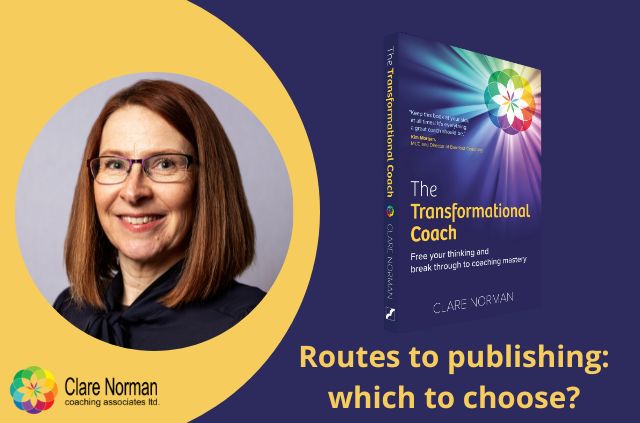
The Transformational Coach: free your thinking and break through to coaching mastery [link] is through a hybrid publishing house. What do I mean by hybrid? Well they have all the experts to do the work and they manage the whole project, but the author pays for the service. This is not for the faint-hearted, as those costs are high, in my case just under £10K (now you know why traditional publishers only give you 7% as they have to cover their costs). But I get more or less all of the revenue (except where Amazon takes a cut and a warehouse takes an amount). Who knows whether I will make all my money back, but I am thrilled with the service I have received.
You see, in this model, I am the customer and I have final say over everything. And I also get exceptional input from exceptional experts. As I said in my previous posts, I got a huge amount of support and challenge when deciding on my book title and the same for my book cover. I also got lots of feedback from the initial review of the manuscript, which led to a much better book. Every step of the way, I have felt special. I really like this model, though I realise that I couldn’t have afforded to do it when I first set up my business.
So there you have it, my run-down of my five different experiences. I hope it might shed some light for you, if you are in the early stages of thinking about writing a book.




Thanks Claire – interesting information. Can I ask the name of the hybrid publishing house for you last option? Thanks!
of course Rachel. Are you headed into a writing project?
I worked with Sue Richardson Associates, and the publishing house is Right Book Press. I had a great experience working with them.
There is another one I have come across, which I didn’t mention and that is a Crowd-sourcing option. A friend of mine is working with Unbound. You basically ask people for money up-front in exchange for a book, or a bundle of books or some other service and then when you have raised enough money to cover all of the publishing costs, the publishing house gets to work on it. Another option to consider.