
Last week, I set out the International Coach Federation coaching competencies. Now it’s time to delve into each one in turn, starting with Meeting Ethical Guidelines and Professional Standards. You might think this doesn’t apply to leaders as coaches, only professional coaches. But it’s just as important for leaders as coaches, as there are multiple
For leaders

Coaching competencies for leaders
The case for coaching is clear. Now let’s look at how leaders apply coaching competencies in their work with their team members. Over the next few weeks, I’ll be highlighting the International Coach Federation coaching competencies, and how they translate into the workplace. As a taster, here they are: Setting the Foundation Meeting Ethical Guidelines
Creating independent critical thinkers
I often hear leaders saying that they don’t need to use a coach-approach to leading their people; they just need to tell them what to do and their people will get on with it. They are forgetting the power of independent critical thinkers. Yes you can do that (tell rather than coach), if you want

The leader experience and derailers
When a leader’s experience is on an upward trajectory, working through the leadership pipeline, it can be tempting to become blase about that progress. So often though, leaders derail. The Center for Creative Leadership has studied what derails leaders and found five derailers get in the way of their continued success. These derailers are all things
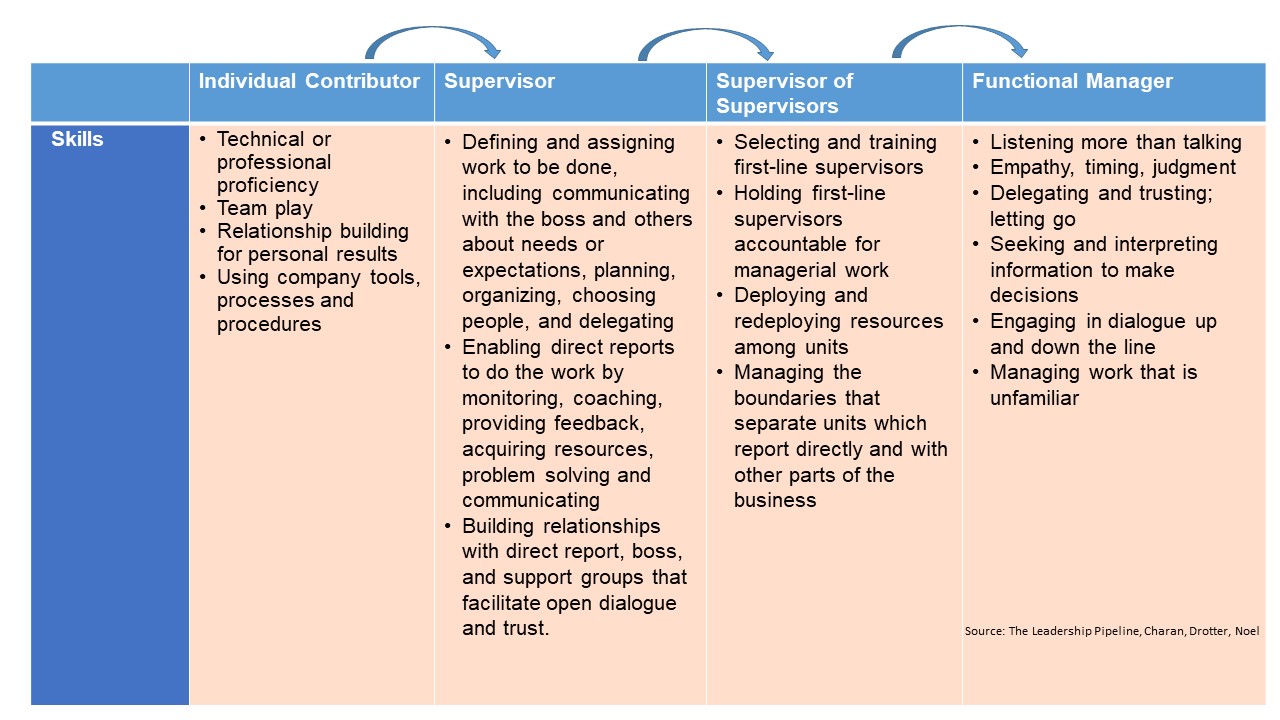
The leader experience and the leadership pipeline
All leaders need coaching and feedback, no matter what their level in the leadership pipeline. They may need other things along their journey too, to ensure that they have the best leader experience from the first time they take on a leadership role to the end of their leadership careers. In the Leadership Pipeline, by Charan,

Leader experience
I look at everything through an “experience” lens. Customer experience, employee experience, coachee experience. I’ve recently turned my thoughts to the leader experience. What makes work a great experience for leaders? They are employees of course, so the employee experience relates just as much to them as it does to anyone else at any
Peacetime and wartime leadership skills
We’ve heard about Winston Churchill’s amazing leadership during the war, and his lacklustre performance during peacetime. The same happens with leaders in the more metaphorical sense of wartime and peacetime, and yet leader developers sometimes forget that the skills needed are different. Peacetime being when things are going well, wartime being when the environment is

Teresa May: from command and control to coach-approach
This week’s news in the UK has been fascinating to me, particularly as it relates to Teresa May’s leadership style and her lack of a coach-approach. I understand why she couldn’t step down from her prime ministerial role, after talking about strong and stable leadership. Stepping down would make a mockery out of that statement (if
Coachability: a belief in your ability to make changes
Coachability – an interesting word! You may be surprised to hear that not everyone is coachable. As Ginnie Baillie says: “Ultimately clients are not buying you or coaching, they are buying their belief in themselves and their goals.” So it’s important to help a potential new client to get clear about whether they believe in

Mastermind Groups develop high-performing leaders for business growth
Mastermind Groups develop high-performing leaders to create lasting value for your business As executives get more and more senior, they seem to have fewer places to talk about the problems they are facing. Talking to their peers can feel threatening due to the performance competition between them. Talking to their people may feel like admitting

The Land of Many Tractors: Slow Down
Penny Gundry writes: Last week I was working down in the South West of the UK, the land of many tractors. The country roads are narrow and the tractors are very slow. And so it was, on a stretch of road with no turnings off for miles, I found myself behind a tractor towing a
Manage your Priorities and their Expectations: Just Say No
Today’s post, “Just Say No,” comes from my dear friend and brilliant coach/coach supervisor, Diane Clutterbuck. Diane writes: Meet Tom, a senior manager in the Health Service who I have been coaching through a period of transition. In a new role where he still carries much of his former responsibilities, plus new ones, Tom is

The importance of place
Today’s post is by my very perceptive colleague William Buist. Our conversations occur in many interesting place, that enable us to do our best thinking together. William writes: I’ve run Mastermind groups for many years and they are enormously powerful gatherings that lead people to both expose elements of their business, and themselves, to scrutiny in ways that

The magic in the middle of coaching
I’m being facetious of course, talking about magic in the middle of coaching. But if you can create a shift in the room, that does feels pretty special. To create that shift, we don’t tell people what to do. That’s more likely to create push-back, even if it’s not immediate. People tend to do things

When coaching, endings are critical
Most of the value in a coaching conversation comes from what happens after we have left it. So great endings are critical to make sure that value actually materialises. In my work, I use CLOSE to remind managers as coaches how to wrap up well. It’s great for team meetings too – no need to

When coaching, start with the end in mind
Stephen Covey reminds us to start with the end in mind. Any great coaching session will do just that, starting with the end in mind. In my work, I use a model to contract well, called CONTRACT. Whether you are a professional coach or a manager as coach, it works to provide a container within which new