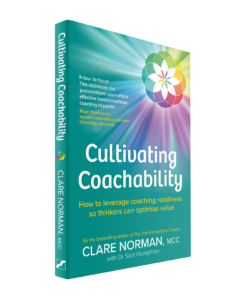
I often hear leaders saying that they don’t need to use a coach-approach to leading their people; they just need to tell them what to do and their people will get on with it. They are forgetting the power of independent critical thinkers. Yes you can do that (tell rather than coach), if you want
Developing People Is our Business

The leader experience and derailers
When a leader’s experience is on an upward trajectory, working through the leadership pipeline, it can be tempting to become blase about that progress. So often though, leaders derail. The Center for Creative Leadership has studied what derails leaders and found five derailers get in the way of their continued success. These derailers are all things
Coachability: a belief in your ability to make changes
Coachability – an interesting word! You may be surprised to hear that not everyone is coachable. As Ginnie Baillie says: “Ultimately clients are not buying you or coaching, they are buying their belief in themselves and their goals.” So it’s important to help a potential new client to get clear about whether they believe in

Coaching – Return on Humanity?
I’m pondering the Return on Humanity that coaching has. When I left Accenture, one of my colleagues described me as the voice of humanity. I think that was because I banged on about people creating profits, so if an organisation starts by creating a great employee experience for those people, then the profits will fall into

Coaching to Support the Employee Experience
We’ve concluded our series about how coaching can (and should?) support the employee experience. For those of you who wish to catch up on posts that you have missed, or if you like to have everything all in one place like I do, here is the full catalogue. The key messages about coaching to support the

Coaching, training or mentoring?
I often have to explain that coaching is not the same as mentoring, training or counselling. I thought it might be useful to take a step back and reflect on the differences between various forms of capability development options, and their different uses.

Drama Triangle to Winner’s Triangle
The Drama Triangle Like the parent, adult, child model that we looked at on Friday, this is from the Transactional Analysis world. I use it on myself all the time, to work out where I am operating and whether there is a more useful place to be in the Winner’s Triangle. The triangle has three roles,
Transitions – transformational vs transactional
I’ve noticed something about transition coaching (especially outplacement coaching). Some outplacement companies support their clients through the transactional side of finding a new job. Things like writing their CV, applying for roles, composing a cover letter, interview skills. That’s good – as far as it goes. But there is something missing from that equation. Change provides
The employee experience: Coaching to join an organisation
Let’s turn our attention to coaching to join an organisation. In our series on coaching to support the employee experience, we’ve looked at: Joining or re-joining the workforce A change in role Changing role Leaving an organisation through choice, or through redundancy And only now do we come to joining an organisation. Does it seem
Coaching to leave an organisation – redundancy
Last week, we teed up the idea of coaching to help employees who are leaving an organisation, through their own choice. Let’s now look at coaching to support people at a time of redundancy of role (I think that is a peculiarly UK phrase, which in other countries may be called being let go. This
The employee experience: coaching to support leaving an organisation
We’ve almost come to the last chapter, with our employee experience journey, where we started with the employee joining the workforce and now we are looking at coaching to support leaving the organisation – or even leaving the workforce through retirement. If you are just joining our journey now, you might want to catch up on what
The Employee Experience: Coaching to Change Role
Coaching to change role can help you in multiple forms of changing role: Sideways move to a similar role in a different function Individual Contributor to first time manager Managing others to managing a function Managing a function to managing a business Coaching can help at different stages of the decision-making journey. For example, you
Coaching the Employee Experience: Change in Role
In this series, we’re looking at how to use coaching to support a phenomenal employee experience during the transitions that employees encounter in their careers. Coaching isn’t the only intervention of course, but it can help the employee to work with the psychological impact of change – what are they leaving behind, what are they
The employee experience: re-joining the workforce
In this series, we’re looking at how to use coaching to support a phenomenal employee experience during the transitions that employees encounter in their careers. Coaching isn’t the only intervention of course, but it can help the employee to work with the psychological impact of change – what are they leaving behind, what are they
The employee experience: joining the workforce
In this series, we’re looking at how to use coaching to support a phenomenal employee experience during the transitions that employees encounter in their careers. Coaching isn’t the only intervention of course, but it can help the employee to work with the psychological impact of change – what are they leaving behind, what are they
Coaching to support the employee experience: the organisational lens
We’ve looked at how a coachee might decide whether to ask for coaching from their manager, from an internal coach, or from an external coach, depending on how transparent they feel they can be; we’ve also looked at how a manager-as-coach, internal or external coach might decide whether they can provide the service to the coachee.