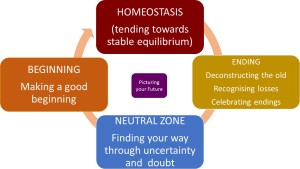
Having looked at homeostasis and endings, it’s time to move into that uncomfortable neutral zone, where you are neither here nor there. Generally, people want to get out of the neutral zone as quickly as possible, but this is a time for reflection – almost like a sabbatical – to let things figure themselves out. You can’t rush this phase; things fall into place in their own good time, including the new attitudes and habits we need to adopt in order to make a great new beginning.
The kinds of questions that help in the Neutral Zone might look like these:
- How can you take care of yourself right now? What do you need to do to sustain yourself during the transition?
- How can you build your energy for the new beginning, physically, mentally, emotionally, spiritually and administratively?
- How can you surrender to the emptiness?
- What do you want to call this period? What would be a good and motivating metaphor for your neutral zone?
- What attitudes, outlook, values, self-image, ways of working and thinking that were previously functional need to shift for the next chapter of your work life to be a success?
- What has worked well and how might you build on that ?
- What has not worked well and what do you need to do to end or change this?
- What is in your circle of concern right now? What is in your circle of influence?
- What kind of short term goals do you need? Are those goals and targets realistic for this neutral zone?
- What are your training needs?
- What/who do you need to help you feel connected?
- What creative work can you do now that wasn’t possible before? What opportunities are you seeing now?
- What processes do you need to redesign?
- What structures can you put in place to help you in the future?
- How can you avoid the traps of fast forward and reverse? (the desire to move too quickly without a definite plan; and the desire to go back to the way it was)
- How can you carve out regular alone time? How might you use a retreat? A sabbatical?
- What is trying to happen?
- What is your mood?
What additional questions do you think might be useful?
Credits to Diane Clutterbuck, William Bridges, Judy Oliver