
Establishing Trust and Intimacy with the person you are coaching is paramount if they are to do their best thinking. They need to feel confident that they can be vulnerable and share their truths, their whole truths and nothing but their truths. If they keep certain things to themselves for fear of being judged, they
Coaching Culture
Creating independent critical thinkers
I often hear leaders saying that they don’t need to use a coach-approach to leading their people; they just need to tell them what to do and their people will get on with it. They are forgetting the power of independent critical thinkers. Yes you can do that (tell rather than coach), if you want

Coaching: Return on Humanity part 2
A few weeks ago, I argued that coaching needs to be measured by its Return on Humanity, not just its Return on Investment. I’ve taken a look at the research that proves that coaching really does have a return on humanity. Return on Humanity: Goal-striving, Wellbeing and Hope By that I mean that it makes

Supervision for internal coaches
It’s vital that coaches stay sharp and stay safe through supervision, for their own and their clients’ wellbeing. When I reflect on my time as an internal coach, and the kinds of things I took to supervision, they focused mostly on boundary management. Supervision questions For example, how did I start and maintain an adult to adult relationship with

Coaching – Return on Humanity?
I’m pondering the Return on Humanity that coaching has. When I left Accenture, one of my colleagues described me as the voice of humanity. I think that was because I banged on about people creating profits, so if an organisation starts by creating a great employee experience for those people, then the profits will fall into

Evaluation of Coaching
Refreshing evaluation of coaching Organisations want to know that their investment in coaching has paid off. It was very refreshing, then, when I asked the sponsor of a recent coaching programme what he thought the return on investment was to the business. His reply…she (the coachee) had invested in her future at the company, allowing

Creating a coaching culture using Social Movement Theory
Can you create a coaching culture from the middle of an organisation? That was the question posed to me a few weeks ago by a Senior Manager in a University, who didn’t have the authority to do so, according to her role description, but absolutely had the passion. I suspect this happens more often than
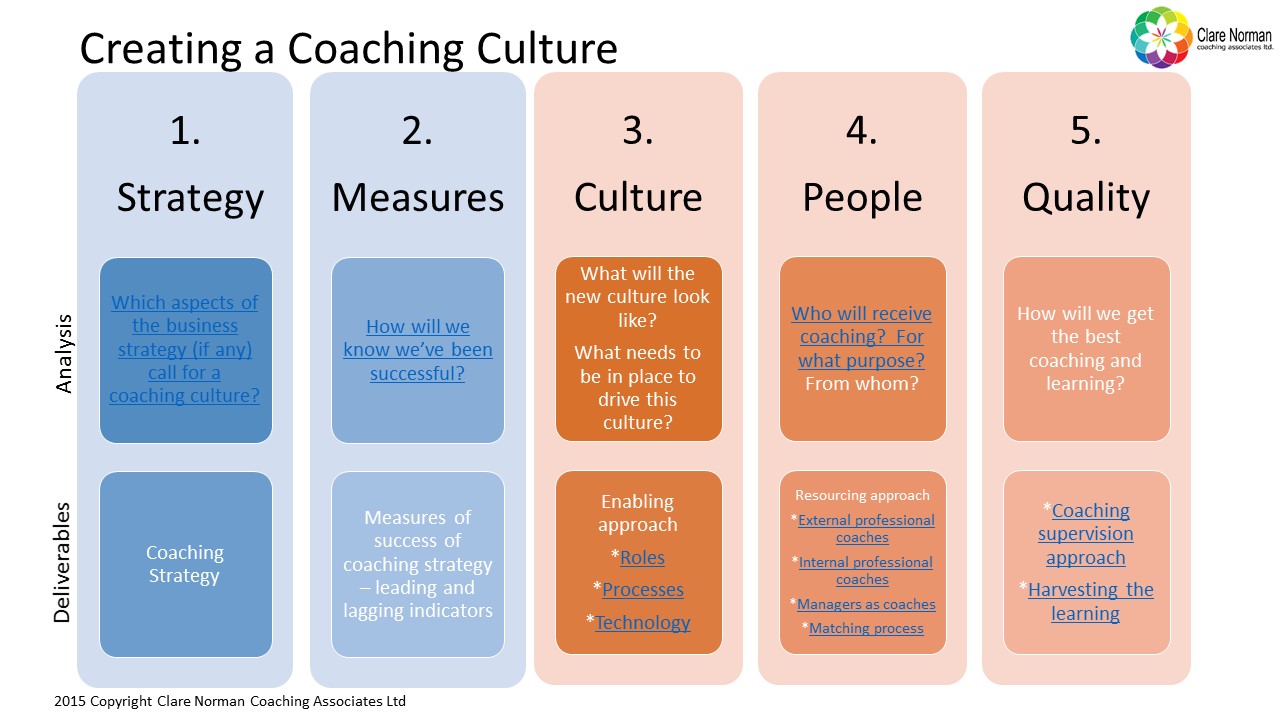
Creating a Coaching Culture
Creating a Coaching Culture requires the same kind of rigour as any other culture change. That includes articulating your end-point and how you will recognise success when you see it, then pulling a multitude of levers to enable you to get from where you are today to that end goal. Those levers include technology, process and
Technology to support the coaching culture
Technology is an enabler. It enables you to be more effective and efficient; and to make informed decisions. Your coaching strategy will lead you to the kind of technology you need to underpin it. You can see the full blueprint for Creating a Coaching Culture here. Working through the coaching strategy blueprint, you might use technology
Coaching Culture: Internal Coaches
Why create an internal coaching function? If, like many organisations, yours does not have a strategy for coaching – or a function to manage whatever coaching is happening – it can cost the organisation not only money, but lots of opportunity costs too: not aligning to the business strategy not gaining economies of scale not measuring
Coaching Culture: Coach matching
Today’s post is from guest blogger, Stan Woster, of Coachmatch. As the name suggests, this is a company that matches coaches to clients. So I asked Stan to give us his top tips for matching. Stan writes: As Head of Client Services at Coachmatch, I hold responsibility for the delivery of our Coaching services into
Coaching Culture: Harvesting the Learning
In order to make sure that an organisation gets added value from coaching, consider how you are “harvesting the learning” at a thematic level from all of the coaching that is going on. Often, coachees bring similar issues to coaching, and sometimes they are issues that could be better addressed at the systemic level, rather than
Coaching culture: coaching supervision
Why coaching supervision? “The purpose of supervision is learning that leads to the continuous development of the conscious competence of the supervisee and the supervisor and to a higher level of practice. At its core, supervision implies an accountability to learning – that of the supervisor and supervisee – that may extend to that of
Coaching culture: roles
If you like to see the big picture of how this series fits together, take a look at this blueprint for Creating a Coaching Culture. I’ll continue to write posts that fill in the boxes. Today’s post gives us an insight into the roles needed to support the creation of a coaching culture. First and
Coaching culture: where can coaching add value?
So far, in our series about creating a coaching culture in an organisation, we’ve looked at what is the problem you are trying to solve?, experiencing coaching, integrating coaching into every process and how will we know it’s been successful?. What else do we need to think about when creating a coaching culture? You know from the above what
Coaching Culture: how will we know it’s successful?
Evaluation of your coaching culture starts at the end result – with the performance outcomes for the business. But that doesn’t mean that you should wait to come up with an evaluation strategy until the work has started or even ended, because you might end up doing the wrong work that doesn’t lead to the measures of success