
Given my recent award for a series of articles in Coaching at Work (links at the bottom of this post), I thought you might be interested in how I got here. How I got to being an award-winning writer. Gosh, that sounds grand. I need and want to own that – I am an award-winning
Tag: conversations
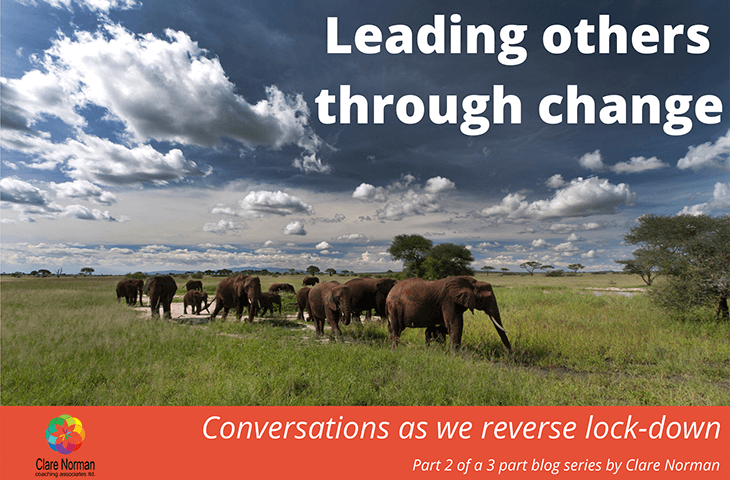
Leading others through change – Part 2
In part 2 of this 3 part blog series about leading through change, Clare Norman discusses the conversations leaders might have as lock-down is reversed.

When to Use a Coach Approach ~ Summary: Leader as Coach
In this series for the Leader as Coach, we’ve looked at multiple conversation points where coaching – or at least a coach approach – will engage your employees more than telling them. In brief, whenever you have any of these conversations, structure them by: contracting at the start for what you each want to take

Leaving an Organisation ~ Leader as Coach: When to use a Coach Approach
You might think that once a person has handed in their notice and leaving, that’s it. You can’t afford to waste your precious time on them, when you need to look forward to finding their replacement and getting them trained up. But wait. This person might be a great asset to you and your organisation,

Career Change ~ Leader as Coach: When to use a Coach Approach
One of your team members appears to be disengaged and bored with his role. He’s very capable, but his heart just isn’t in it anymore. You’ve been doing what you can to motivate him, but you haven’t managed to find that sweet-spot in your team that would make the most of his strengths, his passions

Team Meetings ~ Leader as Coach: When to use a Coach Approach
So far, we’ve looked at one-to-ones and feedback that uses a coach approach. Let’s move on to team meetings. As always, contracting is really important, to ensure that everyone knows what they are there for. What’s the purpose of the meeting, what are the desired outcomes and what will success look like by the end

Corridor Conversations ~ Leader as Coach: When to use a Coach Approach
Coaching, contrary to popular belief, doesn’t need to be a one hour conversation hidden behind closed doors away from the work, it can be short and sweet too, ‘corridor conversations’. Tweet This! Afterall, as Teresa Amabile says, any progress is good progress. Here are three scenarios. Great opportunities for a bit

Giving Frequent Feedback ~ Leader as Coach: When to use a Coach Approach
Within your one-to-ones, and as you see things that merit it, you will want to give frequent feedback to keep your employee motivated and on-track. Creating and delivering a specific message based on observed performance is vital to effective feedback. You may have told a fellow manager, a co-worker or even your boss that he

One to Ones ~ Leader as Coach: When to use a Coach Approach
When to use a Coach Approach – Overview Previously, you’ve read here that it’s more difficult for a leader to coach his or her team members directly, due to the conflict of interest that you have: you want them to perform well in this role, where they may want to discuss a move to a