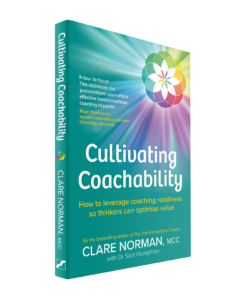

This post is an extract from my Autumn release book about Coachability (title still TBD). It will give you a hint of what awaits you!
I’m driven to innovate, to think afresh, to be a bit edgy and provocative. You might experience that provocation as you read this book. At the same time, I have some angst about naming what I see. What will people think of me? Must I have it all figured out? But there it is, my human fragility front and centre. You can judge me if you wish, but I would prefer you to use this book to provoke your own thinking around this sometimes-emotive subject of coaching readiness, coachability and agency.
I’ve noticed that coach training companies teach people to coach. No surprise there, you might think. But what I’ve come to realise is that this focuses on the coaching session. Again, no surprise there. I’m all for that focus on how you coach, not how you talk about your coaching. That’s why I endorse and invest in mentor coaching (observed coaching using a benchmark set of competencies to give feedback).
But what about all the other parts of the coaching experience? Not the sales and marketing aspects but the thinker’s experience. Where does a coach learn about all of that? And not just the programme of coaching itself, which the coach has control over, but also the essential wrap-around parts of the experience, which involve other stakeholders, particularly in organisational coaching conducts. What you will read here about the elements of the end-to-end experience is underpinned by the International Coaching Federation (ICF) Code of Ethics.
Alongside internal and external coaching experience, I have a background in human-centred design. That means putting the human at the centre of how we design products and experiences, in this case putting the thinker at the centre of the coaching experience. You might call this ‘experience design for thinking’. That’s why I will cover the whole coaching experience in this book.
It’s not all up to the coach to draw out coaching readiness. This is an end-to-end experience that we’re designing here. There are many other stakeholders involved in this experience: for example, the coaching custodian in an organisation, the sponsor, peer support. We’ll be highlighting their roles in coaching readiness as well as the roles within the dyad of coach and thinker, who do not operate in isolation.
I’m fascinated by this idea of coaching readiness and have been exploring the coaching experience through that lens.
Coachability was a term I heard frequently about 15–20 years ago, but it seems to have died away, even though coaches’ frustrations with it have not. Now that I’ve been coaching for more than 20 years, I wanted to revisit what I prefer to call coaching readiness through a more experienced lens but still with a beginner’s mindset.
As T S Eliot wrote in 1942, ‘We must not cease from exploration, and the end of all our exploring will be to arrive where we began and to know the place for the first time.’ This book is a product of my continued exploration of coaching readiness and agency, an exploration that I suspect will never cease. As I said, it’s a book that I hope will provoke you to think for yourself, not necessarily to take my word for it. It’s an invitation to think with me. None of us has the definitive answers to anything in this complex world of ours. But this is the way I see things today, as I write. My thinking will no doubt evolve well after the book goes to print.
I don’t pretend to have all the answers. That’s the ‘tyranny of the together coach’ (a phrase shared with me by my current coaching supervisor, Simon Cavicchia), who feels they need to have it all figured out. I’m not falling for that! And much of what I’ve learned comes from others who have come before me, many of whom I will quote, where I know where the insights emanated from. I hope to have distilled some useful information here, practical applications that will enable you to draw out the best thinking from those you coach. You can then take your own wonderings to supervision, to enhance your own skills in screening for and enhancing coaching readiness and coachability.
I see this book as the companion, perhaps even the twin, to The Transformational Coach (Norman 2022), in which I say that coaching is a joint endeavour, a partnership. So how do you enable the thinker to fully inhabit the role of partner rather than consumer? All of your masterful coaching only really works if you focus on their coaching readiness as well as your own.
That coaching readiness isn’t necessarily innate. If the thinker has never experienced coaching before, or if they’ve had a different form of coaching to that which you offer, they’ll come to coaching in a naïve and innocent state about what it is and how to get the most from it. You know much more than they do about how the process of coaching works, so it’s up to you – and other stakeholders in this whole experience – to open their eyes to the potential of coaching, should they choose to embark wholeheartedly on an exploration of who they are and what’s most meaningful to them.
In my experience, coaches work too hard to create value. It’s not exclusively your role to do this, but the thinker’s and the other stakeholders’ roles also. I do want thinkers to walk away with value from their coaching, but not to the extent that I’ll do the thinking for them.
If you haven’t done so already, I encourage you to read or listen to The Transformational Coach to understand the mindsets that you need to unlearn to be a more masterful coach, such as not trying so hard. This book that you have in your hands now is about the mindsets we can encourage thinkers to unlearn and replace with more coaching-ready mindsets. But start with yourself first. And be more demanding of the other stakeholders in the process too. I hope this book might enable you to influence a better set-up of coaching programmes when they’re organisationally funded; and to create a better foundation when the coaching is individually funded.
I’ve found myself getting more and more interested in the role that context plays in coaching. My job is to support and challenge people to think rather than toe the party line, and it’s not to collude with the system that’s paying me. It’s time to rail against the efficiency paradigm that goes on in organisations and hold them to account for effective coaching. That’s their job as well as mine. My intention is to invite you to consider what goes on in the commissioning of coaching and define your own requests of the organisation for more effective coaching to take place. I invite you to test out and experiment with what I offer here, being brave in some cases by requiring more upfront preparation by others.
Please remember that this is a snapshot of my thinking as it stands today, and you’ll be able to build on it, by discussing with peers and your supervisor and by testing things out in your own real world. In the course of writing the book, I became aware of the tension we as coaches put on ourselves for ‘ten-step programmes’ and the ‘one right way’: some of what I write about here, though, is new territory (for me at least), so how we navigate this territory is a work in progress. There’s no one right way, which is why supervision is invaluable for exploratory purposes rather than black-and-white answers.