
You should not try to compensate for lost productivity by working longer hours
Have you noticed your work hours creeping up? Are you trying to keep up with business as usual? It’s not usual though is it? Things have changed and that means that it can take longer to get (some) things done. It can also mean that you have more on your plate to try to keep business afloat.
Pre-Covid-19, working virtually meant that we could get more done. We could get our heads down without being interrupted. We had time to focus. Output was much more important than input. But now that working virtually is the norm, something seems to have shifted. We have more calls, more instant messenger pings – not to mention home-schooling and other roles we need to play. Productivity has gone down, almost certainly. That’s to be expected.
Input (working longer hours) suddenly seems to be perceived as more important than output. How did that happen?
We should not compensate for the lost productivity by working longer hours. That will eat into the time we need to take care of ourselves. You might be thinking that you are only using what used to be your commute time, which was “dead time”. That commute time played an important role in transitioning you into and out of work. Switching on and switching off. Marking the beginning and ending of our working day. For me, that is now a kiss for my husband as I start work and a kiss when I finish. At least, that is my intention! If we no longer have that enforced switch on/off time, we need to proactively create it.
When I started to work from home full-time, my boss at the time said that the quid pro quo might be for me to work longer hours. What’s that old saying about burning the candle at both ends? I ignored him! Or at least, I didn’t make it a habit. I needed that time to take care of myself, so that I could be on top form to work a productive day the next day. We have never been paid for our commuting time, so why would we slip into filling that time with work now? Make it a conscious choice, not a habit that gets in the way of your self-care.
Prioritisation has always been important, but now more than ever. You cannot do it all. Your to-do list may be continuing to get longer, but you need to have some down-time. Stephen Covey talks about the time management matrix, where the top right corner includes activities that are important and non-urgent. If we don’t do the planning and strategy and self-care in this quadrant, we will end up in the quadrant of important and urgent, fire-fighting. In the case of our health, that might mean that all our neglected good intentions to get fit (non-urgent but important) lead us to a heart attack or stroke or diabetes or obesity-related illness (urgent and important).
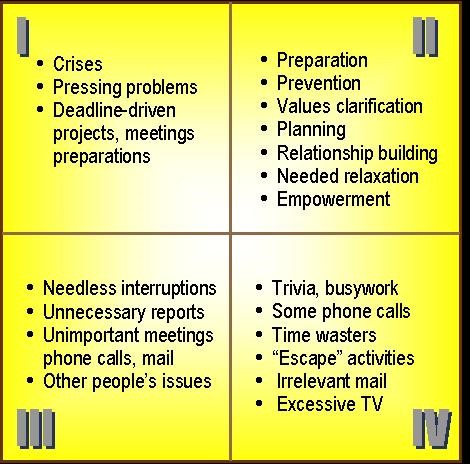
Yes there will be more in the important and urgent quadrant right now as we are in the midst of this crisis, but we also need to review and do what is important and non-urgent so that we don’t make the first quadrant even bigger.
That may require some assertiveness on your part. You may need to say no to some things, or yes, but in this revised timescale.
Being assertive means:
- Being calm, direct, honest and confronting – expressing true feelings and honestly held views
- Standing up for yourself by putting your point of view clearly and if necessary, repeatedly before others
- Respecting the right of others to have a view and express it
- Being prepared to investigate alternatives to resolve differences of opinion
It is not being aggressive:
- Standing up for yourself at all costs
- Taking no account of what other people think or feel
- Being prepared to deride, dismiss, humiliate, belittle or overpower other people and their views
- Going all out for a “win” in any meeting, discussion or confrontation.
Nor is it being passive:
- Failing to express honest and true feelings, thoughts and beliefs
- Allowing others to ignore, trample on, disregard your views and feelings
- Seeking to avoid, appease or “run out” of a situation
- Going to great lengths to prevent others from getting hurt or upset, despite what you feel yourself.
The best prioritisation discussions though, are ones where the two parties sit down together to work out what can realistically be done in the time available. We know we are in a difficult time right now, where faster is better. This is where the three project management constraints come into play. You can have two of the three at any given time – delivery schedule, cost, scope.
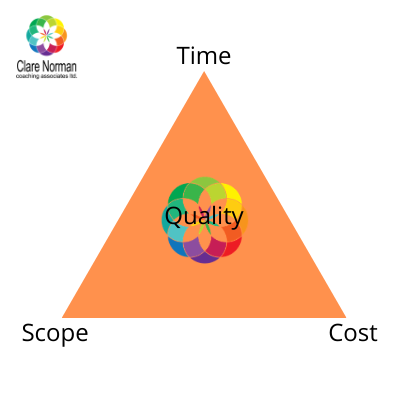
So if you want it faster, you may need to reduce the scope if you want to deliver it at the same cost. If you want to extend the scope, you will either need to wait longer for it or pay more for it (or maybe both). If ou want to reduce costs, you may need to reduce scope or extend the time it takes. Looking through these lenses can help you to have a better conversation about what can take longer, what can be reduced in scope and what can be done with more money.
Right now, there need to be more discussions about altering targets and KPIs. The old ones are unlikely to be feasible, when new ones have been added to adjust for the crisis.
The question should never be – how many more hours can you work in order to get this done? At least not as a long-term strategy. It will lead to burn-out.
Please feel free to leave a comment below, I’d love to know your views.
Further posts in this mini-series can be found here.