Love is important to me, as you know by now if you’ve been following this blog series! And it appears that I am not the only one who is sharing their love of love out loud and into this coaching space. I want to build momentum through this beautifully loving community, so I have invited those I have connected with to write something of their own here. The remit was to articulate something that they hadn’t seen in my writing to date.
So that’s what you’ll get over the next few posts, a range of guest posts about such topics as love and contracting in coaching; love and gestalt; your own personal social history as a coach and where / how you might have learned about love; and much more besides. I am looking forward to hearing your continued expressions of connection (or not) with the nudges towards love in your work.
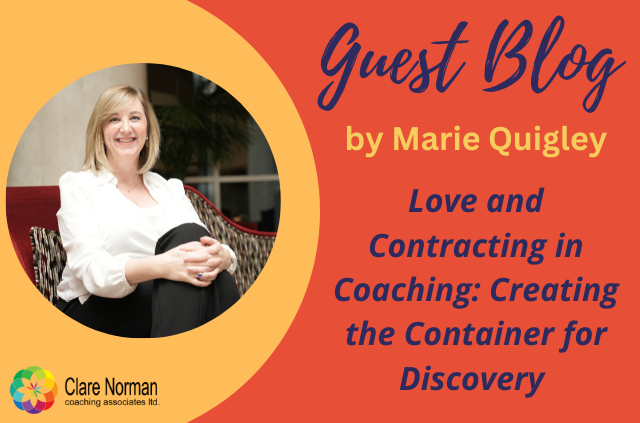
Marie Quigley writes this blog post…
Love and Contracting in Coaching: Creating the Container for Discovery
Coaching, at its best, is not just a transaction of advice or performance tips. It is a relational, intentional, and often deeply personal journey of connection, understanding and partnership. I believe at the heart of this journey lie two powerful forces that may seem contradictory at first glance: love and contracting.
While one may conjure warmth and emotional connection, and the other might evoke images of structure and rules, both are indispensable in coaching. When brought together, they form a dynamic foundation that empowers our clients to stretch, grow, and realise their full potential.
Bringing love into contracting conversations: A courageous invitation
In a recent day of delivering coaching skills to leaders, we explored “Love in Leadership and Coaching” and how it can positively impact the way we lead. And if it’s missing, how it can translate into poor behaviours and outcomes.
We had brave, vulnerable conversations around this concept, and of course, before we dove in, we contracted and discussed openly about how to create a safe and courageous container for exploring this complex topic.
As we gathered to set our intentions and agreements and contract for how we would engage with each other, one of the group members quietly introduced an empty chair. On this chair, with the group’s consent, he placed a simple piece of paper with the words, “Love in Leadership and Coaching,” so that we could include this perspective as we explored the behaviours we wanted to contract for.
It was a powerful and vulnerable invitation. The whole group was not only inviting love to be part of the contracting conversation, they were also modelling love in action.
Their decision to include this perspective represented bold, courageous love. It was more than symbolic. It provided a space to experiment and to challenge the status quo. It created room for a different kind of presence, a listening that was deeper than before and created the safety to get curious about how this type of loving attention could positively impact their leadership and the way they coached.
At its core, contracting conversations are about boundaries, expectations, and shared intentions. They are the foundation of trust. But rarely do we explicitly name love as one of those foundational elements. Is that perhaps because love is often seen as too soft, too emotional, or too personal for professional settings? I believe, love, especially courageous love, is precisely what our spaces need more of.
By placing the chair, it was more than a simple request. It was a being bold and vulnerable way of being. The group modelled courageous love in leadership and, in doing so, showed that love in the context of contracting is not about sentimentality. It’s about showing up fully, daring to ask for what matters, even when it might not be met with agreement. The single gesture and the group’s decision to include this perspective remind us that courageous love is not a weakness to hide but a strength to stand in.
Why should courageous love be in the room when we contract?
- Courageous Love fosters safety. Psychological safety, the sense that we can be seen, heard, and held without judgment, is often the missing piece in the work. Love invites it in.
- Courageous Love brings humanity. When we lead and coach with love, we acknowledge each other’s full humanity. We recognise not just the goals and roles, but the people behind them.
- Courageous Love enables challenging conversations. A contract built on love allows for honesty, accountability, and difficult truths to emerge with respect, care and compassion.
- Courageous Love builds trust. When we sense that love is part of the foundation, we can choose to lean in more deeply. We can trust that we will be met not just with intellect, but with challenge, empathy and connection.
- Courageous Love invites the whole person. Contracting with love gives permission for us to bring more than just our skills or strategies; it invites us to live our values, to listen to our intuition, and be able to own our vulnerability.
Brave conversations
That empty chair was never truly empty. It was a seat filled with intention, presence, challenge and care. It stood for a different kind of conversation, one that dares to be relational before transactional, and puts bravery at its core. In naming love as a contracting element, we remembered that great leadership and coaching are ultimately acts of care with courage in the service of others.
My invitation to us all is that we choose to be coaches who contract and coach not just with mind, but also with heart. That we choose to be leaders who risk rejection in order to foster connection. That we choose to be humans who bring love as a foundational agreement, not an afterthought.
Love – courageous, inclusive, bold love- is not a distraction from our work. It is the very reason we gather to do it.
What would shift in your coaching sessions, your teams, and your organisations if you gave love a seat at the table?
With over 27 years of international experience, Marie understands the challenges involved in leading from the ground up in a volatile, complex, uncertain and ambiguous world. As an executive coach, she partners with senior leaders and high potentials in multi-national organisations, supporting them as they lead through change, transition into higher roles and manage complex cultural business opportunities.
Marie Quigley MCC, marie@mariequigley.com