Love is important to me, as you know by now if you’ve been following this blog series! And it appears that I am not the only one who is sharing their love of love out loud and into this coaching space. I want to build momentum through this beautifully loving community, so have invited those I have connected with to write something of their own here. The remit was to articulate something that they hadn’t seen in my writing to date.
So that’s what you’ll get over the next few posts, a range of guest posts about such topics as love and contracting in coaching; love and gestalt; your own personal social history as a coach and where / how you might have learned about love; and much more besides. I am looking forward to hearing your continued expressions of connection (or not) with the nudges towards love in your work.
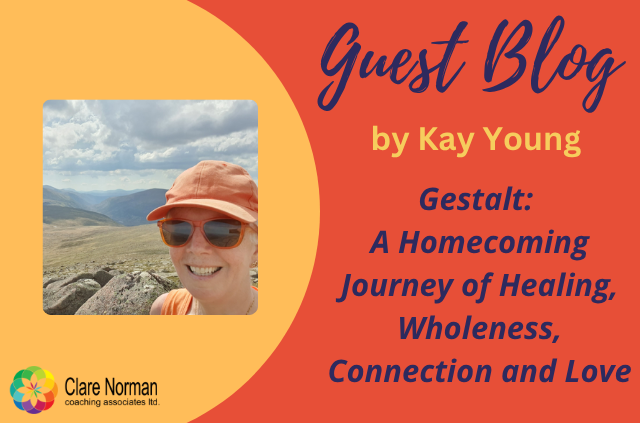
This beautiful blog post is written by Kay Young…
Gestalt: A Homecoming Journey of Healing, Wholeness, Connection and Love
Walking in wild places is my spiritual practice. It has been foundational in meeting myself more fully, in the awareness and aliveness of Now. The mountain landscape is where any lingering sense of aloneness, isolation and separation dissolves, and where a deeper sense of healing, wholeness, connection and love naturally emerges. How I continue to bring these qualities back into the human world, is the question I’ve been wandering with, for the past 10 years.
“Your task is not to seek for love, but merely to seek and find all the barriers within yourself that you have built against it.” (Rumi)
In 2012, my wise and wonderful Gestalt psychotherapist, Karen, likened me to a feral cat. Karen loved her feral cats and respected all the ways they kept their distance and didn’t trust her. Somewhere along the way, in order to protect myself, I’d learned not to trust. Contextual and creative adaptation kept me safe and out of contact with myself and others.
Nine years and 356 sessions later, I emerged from this time of my life with an embodied sense of how being more fully alive, aware and awake is the deepest form of Love. Karen and I wholeheartedly celebrated all I had learned about awareness, acceptance, compassion, healing, wholeness, connection and love, with an invitation to continue to weave this into my life and client work.
Recently, as a result of my GROF holotropic breathwork and psychedelic psychotherapy training, I’ve been initiated into deeper and darker experiences around fear, terror and suffering. Biographical. Ancestral. Collective. In leaning into finding ways of being deeper in the darkness, I’m emerging into an ever-widening, ever-deepening, sense of connection, light and Love, both in life and at work.
As the wise Patrick Connor says, “and then there’s the journey into the depths of the darkness, where the rest of the light is waiting to be claimed”.
This invites the question: What place does love have in my coaching practice?
What’s fascinating to notice, as I ask myself this now, is that I no longer wonder. I have a deep experiential, embodied sense of knowing–
Love is central in coaching practice.
“Even when I’m coaching in corporate environments,” I hear you ask.
“Yes, even then.”
“Even when it’s a C-Suite executive leader?”
“Yes, even then (perhaps even more so).”
This isn’t an essay on Gestalt theory. This is my response to the question: How does my love of Gestalt invite love into coaching? My views are practice-oriented, experiential, and unique to me.
It all begins with deepening awareness of ‘what is’. The practical application of Beisser’s Paradoxical Theory of Change. When we support our clients more fully, to sense, feel, experience and embody, all of ‘what is’– then acceptance, compassion, choice and change become more possible.
This is the start and heart of the homecoming journey.
So, Gestalt coaching is a relational process of: awareness, acceptance (or resistance), compassion, creative experimentation, choice and change.
Gestalt (& Love) says, “let’s you and I slow down enough to notice and be together with all of ‘what is’, because I want you to know that all of you is welcome, right here, right now, with me”.
This includes all parts that have been exiled, suppressed, hidden from sight. The light and the shadow. Trusting that individuals are shaped by the wider field, the context of relationships with others, and the wider environment. In remembering this, everything about a client’s way of being begins to make such sense. These are tender moments. The act of deep noticing. Working in a phenomenological way. Sacred honouring. Deep witnessing. Paying exquisite attention to what is emerging, and inviting clients to be more fully and deeply seen, heard, felt and met, in all of who they are.
With love, we grow our capacity to hold space for another’s process, not just our projection of who we want them to be. It’s about meeting, again and again, in the aliveness of now. This experience of feeling felt, feeling safe, in all our humanness, supports co-regulation, and is the gateway into radical acceptance and deep compassion, for all of what is. It’s where the boundary of isolation and separateness dissolves, and a deep connection is experienced. What Martin Buber calls an ‘I-Thou moment’. In other words–
Love.
Of course, resistance to ‘what is’ is often present: ‘I shouldn’t feel like this’, ‘I want to feel… (anything other than how I do feel).’ The invitation for the Gestalt coach is one of deeply trusting the client’s process, including the energy of resistance, by inviting the client to trust their process, and stay with it, e.g. ‘could you stay with your resistance – sense it, feel it, and show me this part of you, even more fully’. When we honour resistance (which is often fear based), it begins to soften, to melt, to let go of its fierce protective stance. Honouring resistance (and its associated fear) is such a deep act of radical acceptance. When we do this, we open the door to experimenting with choice and change.
Creative experimentation sits at the heart of Gestalt coaching. An opportunity to shift from ‘talking about’ to ‘being with’: sensing, feeling, experiencing. Often this is an internal dialogue between parts of self, or a dialogue with another person e.g. sensing and feeling into the part of you that’s fearful about calling out an ethical issue in the organisation (linked with an old fear of ‘rocking the boat’); and sensing and feeling into another part of self, that’s older and wiser, and ready to speak up on ethical issues. Sometimes I invite my clients to give these parts of themselves names, so in future sessions, we can welcome them back by name! I also invite my clients to take away small experiments of change from each of our sessions, back into life and work.
Awareness is everything. To truly see another, and to allow ourselves to be seen, is a radical act of love, rooted in presence. With awareness comes resistance — our learned patterns, our avoidances, our fears — acceptance of resistance is a compassionate first step—
a step towards Love.
With deepest gratitude to my Gestalt trainers, therapist, supervisors, clients and community.
Kay Young is a Leadership Coach, Coaching Supervisor, and until last month, practised as a Gestalt Therapist. She is currently in Year 2 of GROF Legacy Training. Alongside her psychologically informed coaching & coaching supervision practice, she hopes to co-host holotropic breathwork and psychedelic retreats — for leaders, coaching and supervision clients who are ready for this kind of depth inner work.
Gestalt, and the art and practice of love, continues to weave its way into who she is and how she lives, loves, and leads.
You can connect to Kay via LinkedIn: (1) Kay Young | LinkedIn; and email: kay@kayyoungconsulting.co.uk